Carla Dean
Bag of BonesCarla Dean is a little girl whose death joins the 1933 fire at Halo Bay to the supernatural messages at Sara Laughs decades later. Her name, assembled from refrigerator magnets, is one of the clues Jo Noonan wants Michael Noonan to read; the vision that follows reveals the child behind it and the terrible truth of how she died. The contrast between a child’s plea for her father and his insistence that he is rescuing her makes Carla’s story an intimate record of violence concealed by the language of protection.
Identity and Background
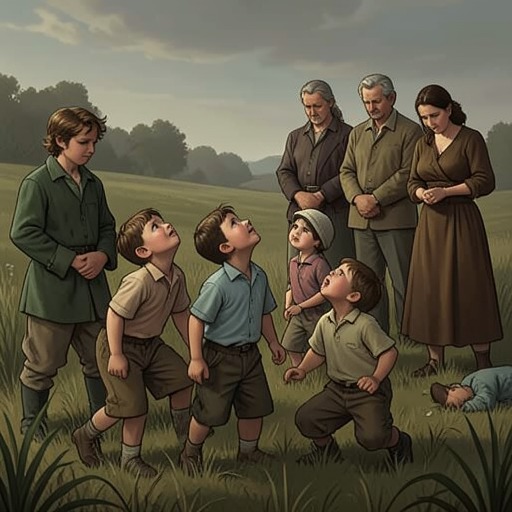
Carla is the daughter of Fred Dean and Hilda Dean, and the sister of Billy Dean. During the fire, she is a very young child, about the age of Kyra Devore, with black hair, bright blue eyes, and a white dress paired with red knee-stockings. Her brother is also a baby, and the siblings are holding hands in the back seat of the family car when their mother gets them there.
Carla’s age and dependence shape the entire episode: she cannot make sense of the danger or escape it on her own. She calls Fred Daddy and reaches for him as he approaches, trusting the parent who has come to take her away from the flames. Her helplessness is set against the adult decisions around her—Hilda’s hurried evacuation and Fred’s later choice to take her into the lake.
The Evacuation and Carla’s Disappearance
The fire advances rapidly after the wind changes, jumping the firebreak and driving toward the far end of the lake. At Halo Bay, people flee in a panic, loading cars with children and possessions until a stalled vehicle blocks the only road out. Volunteer firefighters eventually arrive, but the congestion prevents the Deans from simply turning around and driving back through the jam.
Hilda has put Carla and Billy in the back seat, where they are holding hands. While Hilda loads the trunk, Billy crawls onto the floor and falls asleep. Carla apparently remembers a toy or doll and returns to the cottage to retrieve it. Hilda then drives away without checking the children again. When Fred reaches the car, he finds Billy asleep in the back but Carla gone; she is either still at the cottage or walking up the road, with the fire closing in.
Fred runs back toward the smoke and flame. The account leaves the precise circumstances of Carla’s separation from her mother partly uncertain: her return to the cottage is presented as what must have happened, while the later vision exposes a more disturbing secret about the family’s account of the loss. The fire creates the immediate emergency, but Carla’s death is not simply an accidental consequence of being caught outside. Fred finds her and carries her into the water, where he deliberately holds her under.
The Vision at Sara Laughs
Michael encounters Carla’s history while reading about the fire beneath Jo’s studio. The written account of Fred running toward the smoke is accompanied by a physical, immersive vision: Michael tastes water as if he is drowning, sees the burning lakefront, hears the loons, and finds himself present as a ghost in the past. The scene makes history more than a report about distant deaths; Michael experiences its danger while unable to intervene in the events he witnesses.
He sees Carla sitting on a picnic table, holding out her arms and crying for her father. Fred runs through Michael, who realizes that he is insubstantial to the people of that time. Carla’s plea is directed to Fred, not to the man witnessing her from another era. When Fred scoops her up, Carla asks why they are going into the water. He says it is to escape the fire. She tells him she cannot swim.
Fred wades deeper with her as the flames spread around the lake. Carla’s white dress floats around her, and her red stockings shimmer in the water. She begins to scream; Fred kisses her mouth and continues holding her beneath the surface. He looks toward the unburned western shore rather than watching her struggle, and repeats to himself an explanation that it was an accident: that the water was the only place left, that she panicked, and that he lost his hold on her. The vision contradicts that self-exculpation by showing him deliberately drowning her.
Michael forgets, in the intensity of the scene, that he is a ghost and dives toward Carla, calling her by Kyra’s nickname. He reaches for her repeatedly, but his arms pass through her. Carla, in turn, reaches toward him for help; her hands pass through his. The failed rescue makes Michael’s helpless witnessing part of the scene’s force: he can see the child’s need and the murderer’s actions, but he cannot change the past.
The Name in the Refrigerator Messages
The history of Carla’s death returns in the present through the refrigerator magnets at Sara Laughs. Nine plastic letters draw themselves into a circle and spell CARLADEAN, but an unseen presence rushes past Michael and scatters the magnets, fruits, and vegetables across the kitchen. The cold becomes intense enough for Michael to see his breath, while the brief message is followed by a voice he recognizes as Jo’s, saying, “Oh Mike. Oh Mike.”
Michael understands the name as something Jo wanted him to know, while another presence seems to have tried to prevent him from reading it. The scene distinguishes the two supernatural impressions without fully identifying the force opposing Jo. It also connects the domestic, almost playful image of rearranging refrigerator magnets to a violent act the community’s history has left obscured.
Carla’s name has appeared before among the words Kyra is unable to read for herself, alongside REG. Mattie Devore notes that Kyra has to ask what the letters say and entertains the possibility that she is copying words from a book or learning to write with the magnets. Michael does not believe that explanation. In retrospect, Carla’s name is not an arbitrary arrangement or a child’s exercise: it is part of a recurring attempt to communicate a buried history.
Narrative Significance
Carla’s story is organized around a false rescue. Fred carries her away from the fire, apparently performing the familiar parental act of protection, but the lake becomes the place where he kills her. His repeated story of accident tries to replace what the vision shows, making the gap between his explanation and his actions central to the revelation. The danger of the fire is real, but it also gives him a cover story for a death he chooses to cause.
The narrative first presents CARLADEAN as a fleeting, contested message in Michael’s kitchen, then supplies the child’s appearance, voice, and last moments through the past’s return. This movement from fragmented letters to a witnessed scene turns a name into evidence. Carla’s inability to swim and her repeated appeals to her father make the deception impossible to confuse with rescue; Michael’s inability to touch her, meanwhile, marks the limit of belated intervention. The past can be made visible and its lie exposed, but the child cannot be brought back.